Note
Go to the end to download the full example code.
Combining Stimuli in NRV
This example shows how logical and arithmetical operations on NRV’s stimulus object can facilitate the creation of complex stimulus.
1
500
3
import nrv
import numpy as np
import matplotlib.pyplot as plt

if __name__ == '__main__':
    model = 'Tigerholm'
    diam = 1
    y = 0
    z = 0
    print(diam)

    L = 10000

    t_sim = 50
    t_position=0.05
    t_start=20
    t_duration=1
    t_amplitude=1

    b_start = 3
    b_duration = t_sim
    block_amp = 20000
    block_freq = 10
    dt = 1/(20*block_freq)
    nseg_per_l = 50
    n_seg = np.int32(nseg_per_l*L/1000)
    print(n_seg)
    material = nrv.load_material('endoneurium_bhadra')

    y_elec = 500
    z_elec = 0
    x_elec = L/2

    axon1 = nrv.unmyelinated(y,z,diam,L,model=model,Nseg_per_sec=n_seg,dt=dt)


    E1 = nrv.point_source_electrode(x_elec,y_elec,z_elec)
    stim_1=nrv.stimulus()
    stim_1.sinus(b_start, b_duration, block_amp, block_freq ,dt=1/(block_freq*20))
    stim_extra = nrv.stimulation(material)
    stim_extra.add_electrode(E1,stim_1)
    axon1.attach_extracellular_stimulation(stim_extra)

    axon1.insert_I_Clamp(t_position, t_start, t_duration, t_amplitude)


    # simulate axon activity
    results = axon1.simulate(t_sim=t_sim)
    results.filter_freq('V_mem',block_freq)
    results.rasterize('V_mem_filtered')

    print(results.count_APs("V_mem_filtered"))

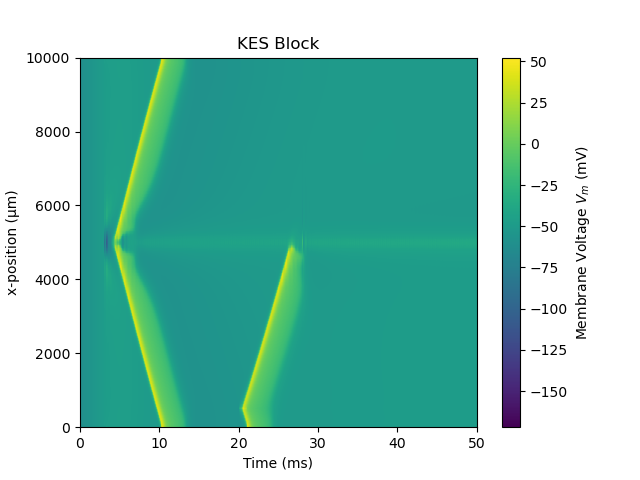
    fig, ax = plt.subplots(1)
    cbar = results.colormap_plot(ax, "V_mem_filtered")
    ax.set_xlabel('Time (ms)')
    ax.set_ylabel('x-position (µm)')
    ax.set_title('KES Block')
    cbar.set_label(r'Membrane Voltage $V_m$ (mV)')

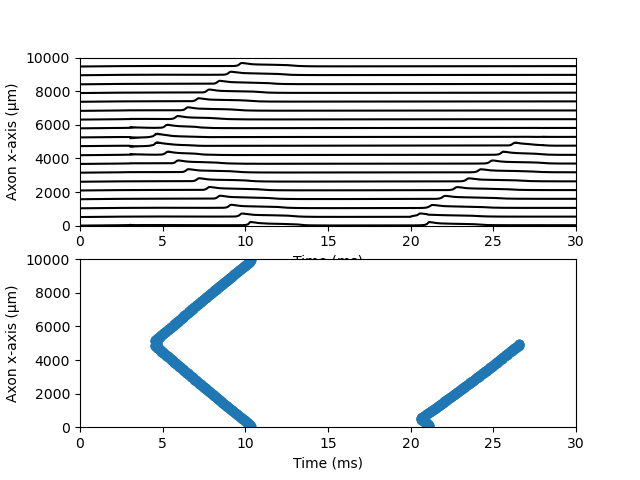
    fig, axs = plt.subplots(2)
    results.plot_x_t(axs[0],'V_mem_filtered')
    axs[0].set_ylabel("Axon x-axis (µm)")
    axs[0].set_xlabel("Time (ms)")
    axs[0].set_xlim(0,30)
    axs[0].set_ylim(0,np.max(results.x_rec))

    results.raster_plot(axs[1],'V_mem_filtered')
    axs[1].set_ylabel("Axon x-axis (µm)")
    axs[1].set_xlabel("Time (ms)")
    axs[1].set_xlim(0,30)
    axs[1].set_ylim(0,np.max(results.x_rec))

    plt.show()
Total running time of the script: (0 minutes 7.117 seconds)