Axons populations
Simulable objects are either single axons, fascicles and nerve. The last two contain one more many axons. Since version 1.2.2, NRV has a dedicated object to store and handle populations, aiming at simplifying the operations associated with large number of axons.
An empty population can be created with an instance of the class axon_population. This object basically couples a list of simulable axons with a geometry (automatically used in FEM simulations). To create new populations of axons, NRV comes with different methods for the two steps described below:
Population Generation: with tools for automated generation of populations with controlled diameters, based on experimental observations.
Population Placement: with Placing and Packing algorithms that shuffles the generated population spacialy, and that shuffles nodes of Ranvier for myelinated fibers.
Tip
- A simple way to see a
axon_population(axon_population.geom) instance is as aCShapecoupled with apandas.DataFrame(axon_population.axon_pop). The fist defining where axons can be placed.
The second gather axons properties and flags to target subpopulation of axons.
- The
pandas.DataFrameaxon_population.axon_popcontains the following information: columns of axon_population.axon_pop DataFrame Column label
type
Description
Flag
"types"intMyelination of the axon (0: unmyelinated, 1: myelinated)
"diameters"floatDiameter of the axon in \(\mu m\)
"y"floaty-position of the axon in \(\mu m\)
"z"floatz-position of the axon in \(\mu m\)
"is_placed"boolTrue is the axon is placed in the geometry
"node_shft"floatRelative x-shift of the myelinated node of Ranviers
…
boolAdditional mask add with
add_mask()-
Note
The Flag column of this table is a built-in property of axon_population returning True if the property is already defined.
Population generation
There are several ways of using/creating populations:
NRV contains some populations and placed populations already defined. Since version 1.2.2, its is easy and fast to generate new populations, these populations should be use for educational scripts only.
a population can be generated using a distribution probability,
a population can be generated from data (stored in various formats)
A simple example of compact code is given in the examples (see example 20)
See also
Example 20 — Axon population generation.
Generate a population from data
Tip
It is also possible to use already created and placed populations of fibers as shown bellow.
It is possible to generate a desired population give two iterables, describing both the axon myelination (1 or True for myelinated axons, 0 or False for unmyelinated axons) and the axons diameters. These iterables can be:
- tuples, in this case, the following syntax should be used, with ax_type and ax_diameters two one dimentional array-like or iterables
import nrv
pop = nrv.axon_population()
pop.create_population_from_data((ax_type, ax_diameters))
- with a unique numpy array combining both myelination and diameters following the next syntax:
- with a dictionnary containing ax_type and ax_diameters two one dimentional array-like or iterables at the keys types and diameter respectively, like in the syntax:
data = {"types":ax_type, "diameters":ax_diameters, "other_key":0}
pop = axon_population()
pop.create_population_from_data(data)
- with a pandas dataframe also containing`ax_type` and ax_diameters two one dimentional array-like or iterables at the keys types and diameter respectively, like in the syntax:
Create ex-novo populations (recommended method)
To create a new population of fibers from scratch, you can use the method create_population_from_stat(). This method will directly feed:
the population’s axon diameters (in \(\mu m\)).
- the population axon types, where
1.0corresponds to myelinated fibers and0.0to unmyelinated fibers. pop.create_population_from_stat(n_ax=100)
- the population axon types, where
The arguments for the function are:
n_ax(int): Number of axons to generate in the population (both myelinated and unmyelinated).percent_unmyel(float): Ratio of unmyelinated axons in the population. Must be between 0 and 1.M_stat(str): Name of the statistical distribution in the library, or a path to a custom CSV file containing myelinated fiber diameter statistics.U_stat(str): Name of the statistical distribution in the library, or a path to a custom CSV file containing unmyelinated fiber diameter statistics.
There are predefined statistical distributions available for unmyelinated fibers, derived from literature. These distributions are interpolated and used as random generators for axon diameters.
Name |
scientific source and comment |
|---|---|
“Ochoa_U” |
From human normal sural nerve, scientific reference [stat1] |
“Jacobs_11_A” |
From human normal sural nerve, scientific reference [stat2] |
“Jacobs_11_B” |
From human normal sural nerve, scientific reference [stat2] |
“Jacobs_11_C” |
From human normal sural nerve, scientific reference [stat2] |
“Jacobs_11_D” |
From human normal sural nerve, scientific reference [stat2] |
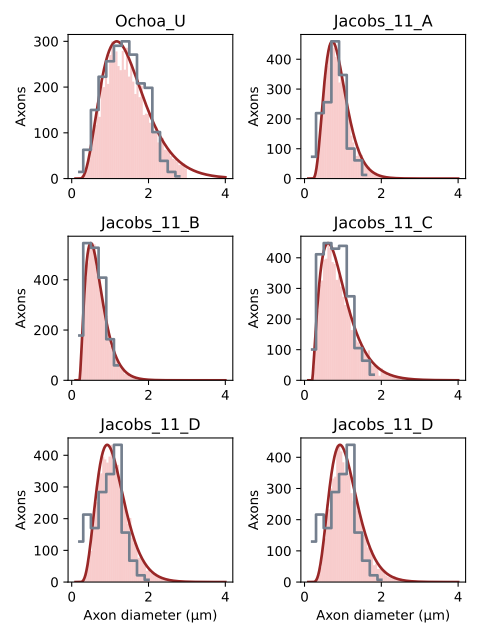
These statistics (grey curves), and their interpolations in NRV (red curves) and an example of generated population histogramm are depicted in the figure bellow:
as well as for myelinated fibers:
Name |
scientific source and comment |
|---|---|
“Schellens_1” |
From human normal sural nerve, scientific reference [stat3] |
“Schellens_2” |
From human normal sural nerve, scientific reference [stat3] |
“Ochoa_M” |
Statistics from human normal sural nerve, scientific reference [stat1] |
“Jacobs_9_A” |
From human normal sural nerve, scientific reference [stat2] |
“Jacobs_9_B” |
From human normal sural nerve, scientific reference [stat2] |
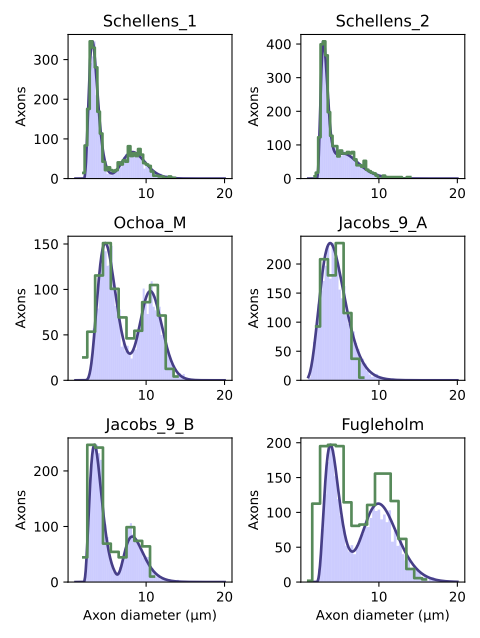
These statistics (grey curves), and their interpolations in NRV (blue curves) and an example of generated population histogramm are depicted in the figure bellow:
The script use to plot those histograms is made available in the examples list
The scientific references used are:
[stat1] Ochoa, J., & Mair, W. G. P. (1969). The normal sural nerve in man: I. Ultrastructure and numbers of fibres and cells. Acta neuropathologica, 13, 197-216.
[stat2] Jacobs, J. M., & Love, S. (1985). Qualitative and quantitative morphology of human sural nerve at different ages. Brain, 108(4), 897-924.
[stat3] Schellens, R. L., van Veen, B. K., Gabreëls‐Festen, A. A., Notermans, S. L., van’t Hof, M. A., & Stegeman, D. F. (1993). A statistical approach to fiber diameter distribution in human sural nerve. Muscle & Nerve: Official Journal of the American Association of Electrodiagnostic Medicine, 16(12), 1342-1350.
Tip
To define a new statistical law, you should store it in a csv files with two columns:
Starting value of the bin for diameter histogram.
Value of the probability for the corresponding bin
The length of the bins is automatically determined by two successive values. Note last bin is the same size as previous one. Sum of probabilities is automatically normalized to 1.
Users can find the predefined statistics at the path nrv/_misc/stats/. Adding files to this folder make the statistics accessible by the filname without the extension. It is also possible to specify the statistics with a string beeing the path to the specific file.
Axon population already existing in NRV
Populations of axons are stored in the framework under the path nrv/_misc/pops as .pop files. These files follow a CSV-like structure with the following columns:
Fiber diameter |
Fiber type |
Not a Number |
Not a Number |
|---|---|---|---|
(in µm) |
(1.0 for myelinated / 0.0 for unmyelinated) |
(NaN) |
(NaN) |
Note
The last two columns are placeholders used to maintain compatibility with placed populations (see below) and to ensure consistent data formatting in the code.
Six predefined unplaced populations are available, corresponding to different total numbers of axons: 100, 200, 500, 1000, 2000, and 5000.
Population placement
The second step to fully define the axon_population consist in positioning the fibres. As for the generation, this can be done:
Using building randomized methods,
From data (stored in various formats)
See also
Example 21 — Axon population placement.
Axon placed population already existing in NRV
Placed populations of axons are stored under the path nrv/_misc/pops in .pop files. These files are similar to CSV files and contain the following columns:
Fiber diameter |
Fiber type |
y-axis coordinate |
z-axis coordinate |
|---|---|---|---|
(in µm) |
(1.0 for myelinated / 0.0 for unmyelinated) |
(in µm) |
(in µm) |
Six predefined placed populations are available, corresponding to different total numbers of axons: 100, 200, 500, 1000, 2000, and 5000.
Axon Placing and Packing
Once generated, the population have to be spacialy distributed, i.e. fibers are automatically placed on the y-z plane with a given proximity and with no overlap. This can be done using two methods:
Axon placing: This method places the fibers on random positions, ensuring that they do not overlap and that they respect a minimal distance between them.
Axon packing: This method places the fibers on a grid and then iteratively moves them towards a gravity center, ensuring that they do not overlap and that they respect a minimal distance between them.
If the packing method is the one that has been historically used in the framework, the placing method is a new addition that allows for faster operations and is more suitable for large populations. The placing method is also more flexible, as it allows for the placement of fibers in a specific area of the grid, while the packing method is more suitable for creating a compact population.
Axon Placing
Axon placing is performed with a single function called placer(), which is designed to interface with the create_axon_population() function detailed previously. The placer function takes care of distributing the fibers on the y-z plane, ensuring that they do not overlap and that they respect a minimal distance between them.
Axon Packing
Starting on a grid, axons are automatically migrated in the direction of a so-called gravity center during a number of iterations. At each step, a velocity for each axon is computed, considering the attraction to the gravity center and the collisions that can occur between cells with a minimal distance to respect between fibers. The animation below is an example of population packing.
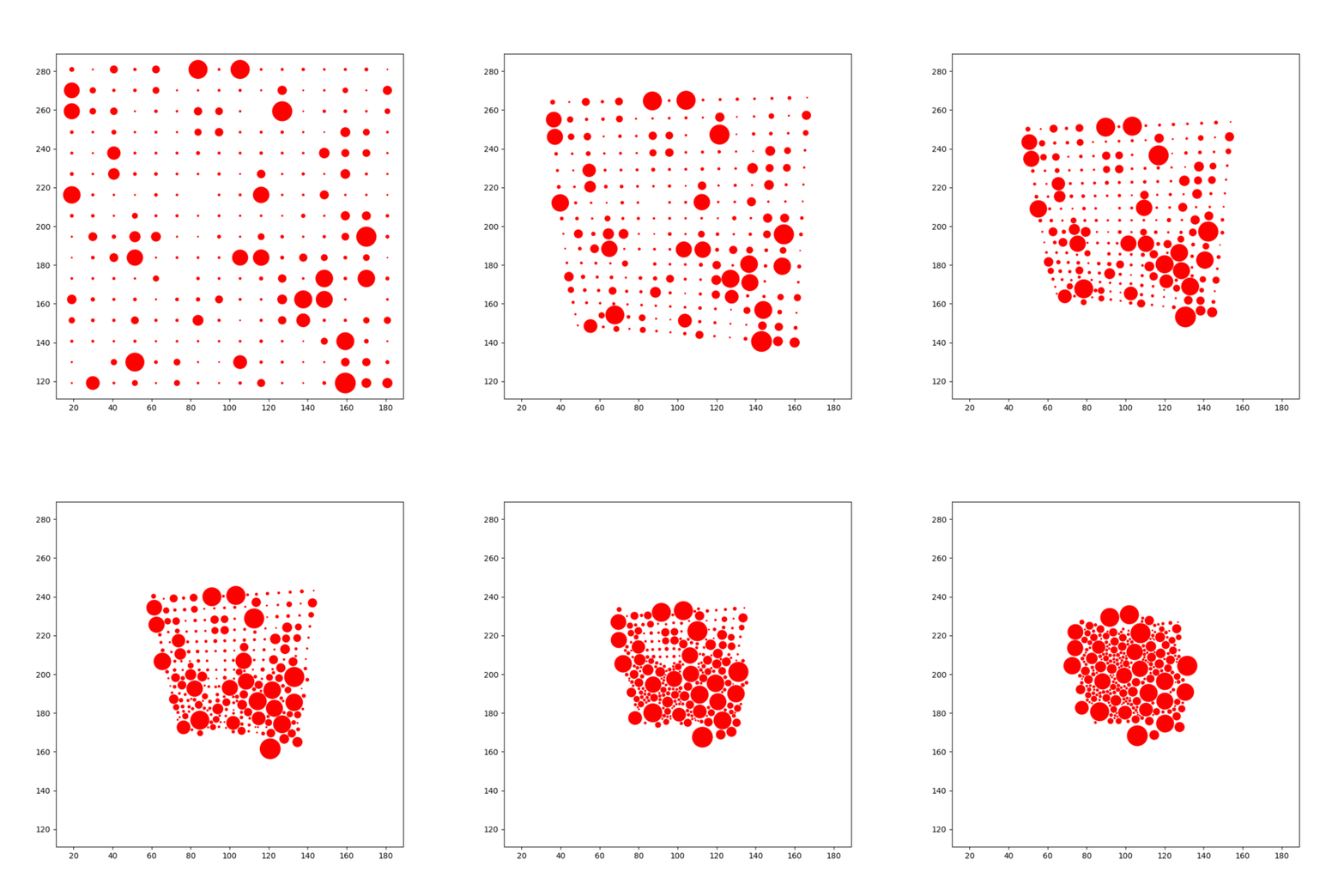
The packing is performed with a single function called axon_packer(), and the function is designed to interface with the create_axon_population() function detailed previously.
Important
The packer only works with circular geometry, not with ellipses neither with generic polygons, and is not recommended. It is maintained mostly for backward compatibility. If the algorithms seems elegant, we noticed that sometimes unmyelinated axons aggregates around myelinated ones, in a strange fashion. It turns out that the placer does not have this behaviour and is computationally much more efficient, especially for large populations. USE PACKING AT YOUR OWN RISK.
Interacting with populations
Basic methods
Methods have been implemented to interact with population in an easy way. If you need to remove some information, two methods for clearing data are implemented:
clear_population that basically get back to an empty population,
clear_population_placement that removes all geometrical properties of the population (generated by the placer/packer).
to handle the placement of axons, two geometrical operations have been implemented:
a rotate method,
a translate method.
A population can be plot using the plot method that takes as parameter the axes of a matplotlib figure.
Populations as DataFrames and playing with masks
More importantly, the structure of an NRV population is based on pandas DataFrames. Theerefore, it is possible for postprocessing of results to:
evaluate conditional expression with the plot method,
add a mask (with the method add_mask) to automatically select a subgroup of the population. When a mask is added, it is associated with a label that can be reused for other operations.
See also
Example 22 — Handling subpopulation of axons.
Example 23 — Attach a current clamp to specific subpopulation of axons.