Combining Stimuli in NRV
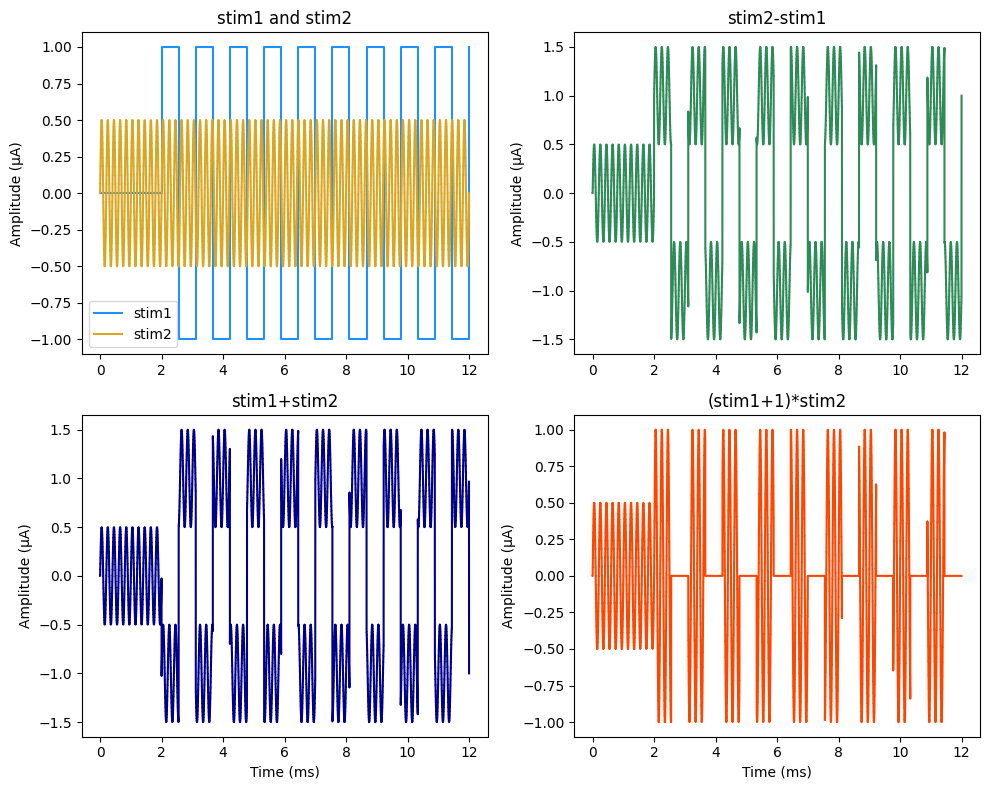
This example shows how logical and arithmetical operations on NRV’s stimulus object can facilitate the creation of complex stimulus.
[ ]:
import nrv
import matplotlib.pyplot as plt
from numpy import exp


if __name__ == '__main__':
    #####################################
    # Example of combination of stimuli #
    #####################################
    stim1, stim2 = nrv.stimulus(), nrv.stimulus()

    # stim1 parameters
    t_start = 2
    duration = 10
    amp1 = 1
    f_stim1 = 1
    stim1.square(t_start, duration, amp1, f_stim1, 0, 0.5)
    # stim2 parameters
    f_stim2 = 5
    amp2 = 0.5
    stim2.sinus(0, t_start+duration, amp2, f_stim2)

    # computations with +,-,*
    stim3 = stim1 + stim2
    stim4 = stim2 - stim1
    stim5 = (stim1 + 1) * stim2

    #print(dir(biphasic_stim))

    fig, axs = plt.subplots(2, 2, layout='constrained', figsize=(10, 8))
    stim1.plot(axs[0,0], label='stim1',color = "dodgerblue")
    stim2.plot(axs[0,0], label='stim2',color = "goldenrod")
    stim3.plot(axs[0,1], label='stim1+stim2',color = "seagreen")
    stim4.plot(axs[1,0], label='stim2-stim1',color = "darkblue")
    stim5.plot(axs[1,1], label='(stim1+1)*stim2',color = "orangered")

    axs[0,0].legend()
    axs[0,0].set_title("stim1 and stim2")
    axs[1,0].set_title("stim1+stim2")
    axs[0,1].set_title("stim2-stim1")
    axs[1,1].set_title("(stim1+1)*stim2")

    axs[0,0].set_ylabel('Amplitude (µA)')
    axs[0,1].set_ylabel('Amplitude (µA)')
    axs[1,0].set_ylabel('Amplitude (µA)')
    axs[1,1].set_ylabel('Amplitude (µA)')

    axs[1,0].set_xlabel('Time (ms)')
    axs[1,1].set_xlabel('Time (ms)')
    fig.tight_layout()
[ ]:
###################################
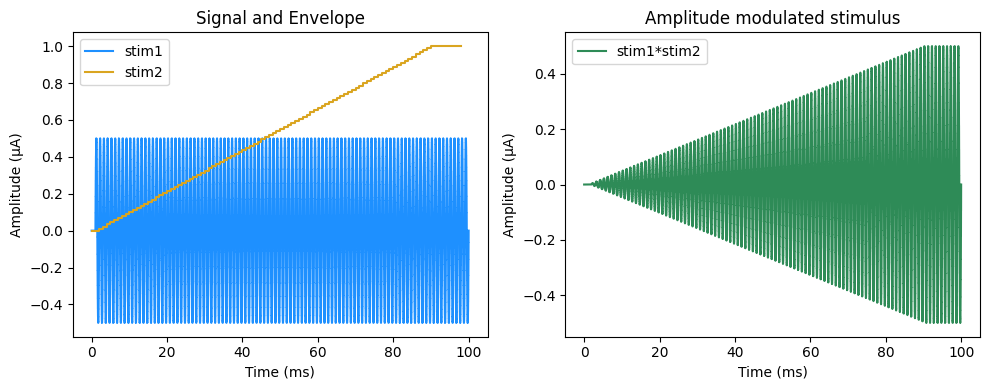
# Example of amplitude modulation #
###################################
if __name__ == '__main__':
    stim1, stim2 = nrv.stimulus(), nrv.stimulus()

    f_stim = 1
    t_start = 1
    duration = 99
    amp = 0.5

    t_ramp_stop = 90
    amp_start = 0
    amp_max = 1

    stim1.sinus(t_start, duration, amp, f_stim)
    stim2.ramp_lim(t_start, t_ramp_stop, amp_start, amp_max, duration, dt=1)

    stim3 = stim1*stim2
    fig, axs = plt.subplots(1, 2, layout='constrained', figsize=(10, 4))

    stim1.plot(axs[0],label = 'stim1',color = "dodgerblue")
    stim2.plot(axs[0],label = 'stim2',color = "goldenrod")

    axs[0].set_title('Signal and Envelope')
    stim3.plot(axs[1],label = 'stim1*stim2',color = "seagreen")
    axs[1].set_title('Amplitude modulated stimulus')

    axs[0].set_xlabel('Time (ms)')
    axs[0].set_ylabel('Amplitude (µA)')
    axs[1].set_xlabel('Time (ms)')
    axs[1].set_ylabel('Amplitude (µA)')
    axs[0].legend()
    axs[1].legend()
    fig.tight_layout()
[3]:
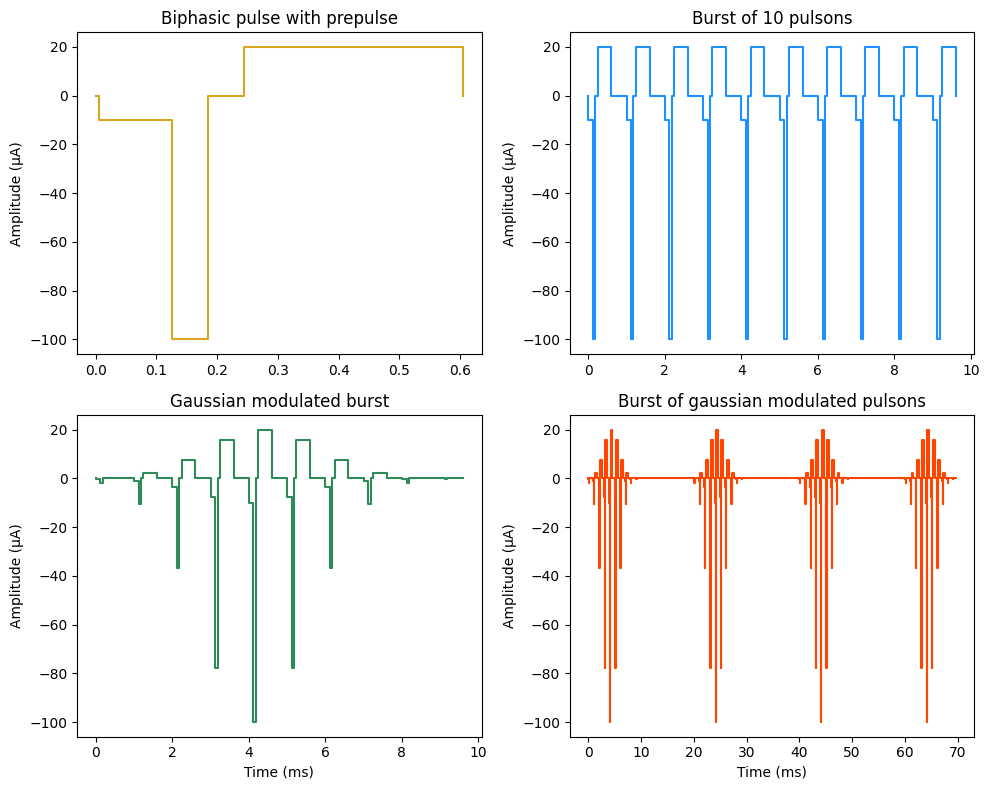
#################################################
## Example of a complex custom stimulus design ##
##                                             ##
## simple pulse with a prepulse and charge     ##
## balance                                     ##
## modulation with a gaussian of borst of 10   ##
## patterns                                    ##
## repetition of the bursts                    ##
#################################################

if __name__ == '__main__':
    start = 5e-3
    fig, axs = plt.subplots(2, 2, layout='constrained', figsize=(10, 8))

    # waveform parameters
    complex_stim = nrv.stimulus()
    prepulse_amp = -10              # in uA
    t_prepulse = 120e-3             # in ms
    cath_amp = -100                 # in uA
    t_cath = 60e-3                  # in ms
    deadtime = 60e-3                # in ms
    an_amp = 20                     # in uA
    # prepulse and cathodic pulse
    complex_stim.pulse(start, prepulse_amp)
    complex_stim.pulse(start + t_prepulse, cath_amp, t_cath)
    complex_stim.s[-1] = 0
    # compute the balancing time and anodic pulse
    an_duration = abs(prepulse_amp*t_prepulse + cath_amp*t_cath)/an_amp
    complex_stim.pulse(complex_stim.t[-1] + deadtime, an_amp, an_duration)
    # plot the pattern
    complex_stim.plot(axs[0, 0],color = "goldenrod")
    axs[0, 0].set_title('Biphasic pulse with prepulse')
    #axs[0, 0].set_xlabel('Time (ms)')
    axs[0, 0].set_ylabel('Amplitude (µA)')

    # create burst of 10 patterns
    freq = 1.                       # in kHz
    # finish the period
    t_blank = 1/freq - (start + t_prepulse + t_cath + deadtime + an_duration)
    N_patterns = 10
    s_pattern, t_pattern = complex_stim.s, complex_stim.t
    for i in range(N_patterns-1):
        complex_stim.concatenate(s_pattern, t_pattern, t_shift=t_blank)
    # plot the pattern
    complex_stim.plot(axs[0, 1],color = "dodgerblue")
    axs[0, 1].set_title('Burst of 10 pulsons')
    #axs[0, 1].set_xlabel('Time (ms)')
    axs[0, 1].set_ylabel('Amplitude (µA)')

    # modulate with gaussian envelope
    def my_gaussian(t, f, N_patterns):
        return exp(-((t - ((N_patterns/2)-1)*(1/f))**2)/4)


    envelope = nrv.stimulus()
    for k in range(N_patterns):
        envelope.pulse(k*(1/freq), my_gaussian(k*(1/freq), freq, N_patterns))

    modulated_pattern = complex_stim * envelope
    modulated_pattern.plot(axs[1,0],color = "seagreen")
    axs[1, 0].set_title('Gaussian modulated burst')
    axs[1, 0].set_xlabel('Time (ms)')
    axs[1, 0].set_ylabel('Amplitude (µA)')

    # construct repeted groups of burst
    N_burst = 4
    f_burst = 0.05
    s_burst, t_burst = modulated_pattern.s, modulated_pattern.t
    t_blank = 1/f_burst - modulated_pattern.t[-1]
    for i in range(N_burst-1):
        modulated_pattern.concatenate(s_burst, t_burst, t_shift=t_blank)
    modulated_pattern.plot(axs[1,1],color ="orangered")
    axs[1, 1].set_title('Burst of gaussian modulated pulsons')
    axs[1, 1].set_xlabel('Time (ms)')
    axs[1, 1].set_ylabel('Amplitude (µA)')
    fig.tight_layout()

    #plt.show()