Note
Go to the end to download the full example code.
Optimization change number of processes
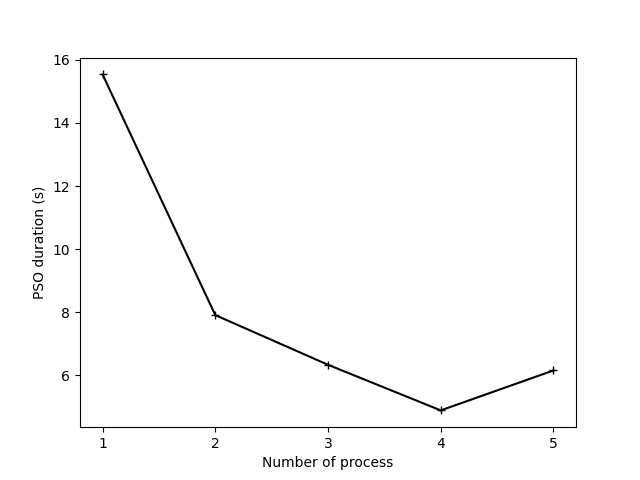
This example shows how to set the number of processes used for optimization. The exact same scenario from Tutorial 5 is used:
The objective is to minimize the energy required by a LIFE electrode to trigger a single myelinated fiber using a rectangular pulse stimulus.
Note
For optimization over parallelizable context (nerve or fascicle), the parallelization is done only for the context simulation
See also
See the Parallel computation and Optimization user guides.
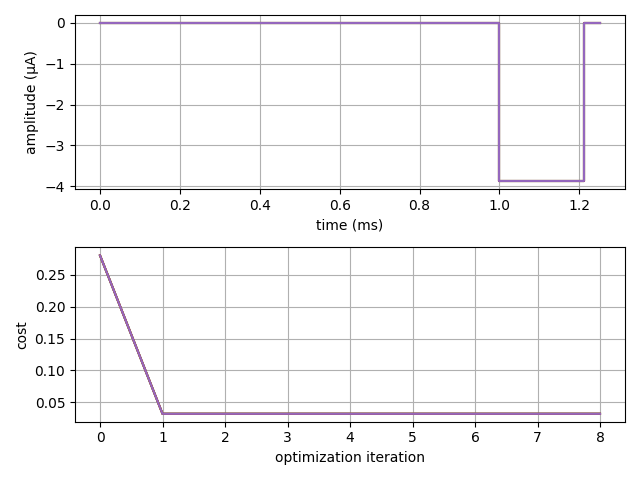
best input vector: [3.8812254810415108, 0.21190886399270414]
best cost: 0.031922483533674786
best input vector: [3.8812254810415108, 0.21190886399270414]
best cost: 0.031922483533674786
best input vector: [3.8812254810415108, 0.21190886399270414]
best cost: 0.031922483533674786
best input vector: [3.8812254810415108, 0.21190886399270414]
best cost: 0.031922483533674786
best input vector: [3.8812254810415108, 0.21190886399270414]
best cost: 0.031922483533674786
import nrv

import matplotlib.pyplot as plt
import numpy as np


if __name__ == "__main__":

    # -------------------------- #
    #  Cost function definition  #
    # -------------------------- #
    my_cost0 = nrv.cost_function()


    # Setting Static Context

    ax_l = 10000 # um
    ax_d=10
    ax_y=50
    ax_z=0
    axon_1 = nrv.myelinated(L=ax_l, d=ax_d, y=ax_y, z=ax_z)


    LIFE_stim0 = nrv.FEM_stimulation()
    LIFE_stim0.reshape_nerve(Length=ax_l)
    life_d = 25 # um
    life_length = 1000 # um
    life_x_0_offset = life_length/2
    life_y_c_0 = 0
    life_z_c_0 = 0
    elec_0 = nrv.LIFE_electrode("LIFE", life_d, life_length, life_x_0_offset, life_y_c_0, life_z_c_0)

    dummy_stim = nrv.stimulus()
    dummy_stim.pulse(0, 0.1, 1)
    LIFE_stim0.add_electrode(elec_0, dummy_stim)

    axon_1.attach_extracellular_stimulation(LIFE_stim0)
    axon_1.get_electrodes_footprints_on_axon()

    static_context = axon_1.save(save=False, extracel_context=True)
    del axon_1

    t_sim = 5
    dt = 0.005
    kwarg_sim = {
        "dt":dt,
        "t_sim":t_sim,
    }

    my_cost0.set_static_context(static_context, **kwarg_sim)

    # Setting Context Modifier
    t_start = 1
    I_max_abs = 100
    cm_0 = nrv.biphasic_stimulus_CM(start=t_start, s_cathod="0", t_cathod="1", s_anod=0)
    my_cost0.set_context_modifier(cm_0)

    # Setting Cost Evaluation
    costR = nrv.recrutement_count_CE(reverse=True)
    costC = nrv.stim_energy_CE()
    cost_evaluation = costR + 0.01 * costC
    my_cost0.set_cost_evaluation(cost_evaluation)


    # -------------------------- #
    #  PSO Optimizer definition  #
    # -------------------------- #
    pso_kwargs = {
        "maxiter" : 10,
        # "maxiter" : 50,
        "n_particles" : 10,
        # "n_particles" : 20,
        "opt_type" : "local",
        "options": {'c1': 0.6, 'c2': 0.6, 'w': 0.8, 'k': 3, 'p': 1},
        "bh_strategy": "reflective",
    }
    pso_opt = nrv.PSO_optimizer(**pso_kwargs)

    t_end = 0.5
    duration_bound = (0.01, t_end)
    bounds0 = (
        (0, I_max_abs),
        duration_bound
    )
    pso_kwargs_pb_0 = {
        "dimensions" : 2,
        "bounds" : bounds0,
        "comment":"pulse"}


    n_proc_list = [1, 2, 3, 4, None]
    best_res_list = []
    duration_list = []
    # Problem definition
    fig_costs, axs_costs = plt.subplots(2, 1)

    for n_proc in n_proc_list:
        np.random.seed(444)
        my_prob = nrv.Problem(n_proc=n_proc)
        my_prob.costfunction = my_cost0
        my_prob.optimizer = pso_opt
        res0 = my_prob(**pso_kwargs_pb_0)
        best_res_list += [res0["x"]]
        duration_list += [res0["optimization_time"]]


        print("best input vector:", res0["x"], "\nbest cost:", res0["best_cost"])


        stim = cm_0(res0.x, static_context).extra_stim.stimuli[0]
        stim.plot(axs_costs[0], label="rectangle pulse")
        axs_costs[0].set_xlabel("best stimulus shape")
        axs_costs[0].set_xlabel("time (ms)")
        axs_costs[0].set_ylabel("amplitude (µA)")
        axs_costs[0].grid()

        res0.plot_cost_history(axs_costs[1])
        axs_costs[1].set_xlabel("optimization iteration")
        axs_costs[1].set_ylabel("cost")
        axs_costs[1].grid()
        fig_costs.tight_layout()

        simres = res0.compute_best_pos(my_cost0)
        simres.rasterize("V_mem")
        del my_prob

    plt.figure()
    n_proc_list_int = [1, 2, 3, 4, 5]
    n_proc_list_labs = [str(i) for i in n_proc_list_int]
    n_proc_list_labs[-1] = "default = 3"

    plt.plot(n_proc_list_int, duration_list, "-+k")
    plt.xticks(n_proc_list_int, labels=n_proc_list_int)
    plt.xlabel("Number of process")
    plt.ylabel("PSO duration (s)")
    plt.show()
Total running time of the script: (0 minutes 48.564 seconds)